
AI is moving onto your own computer
Local AI brings large models closer to a company's own data, costs and everyday workflows.
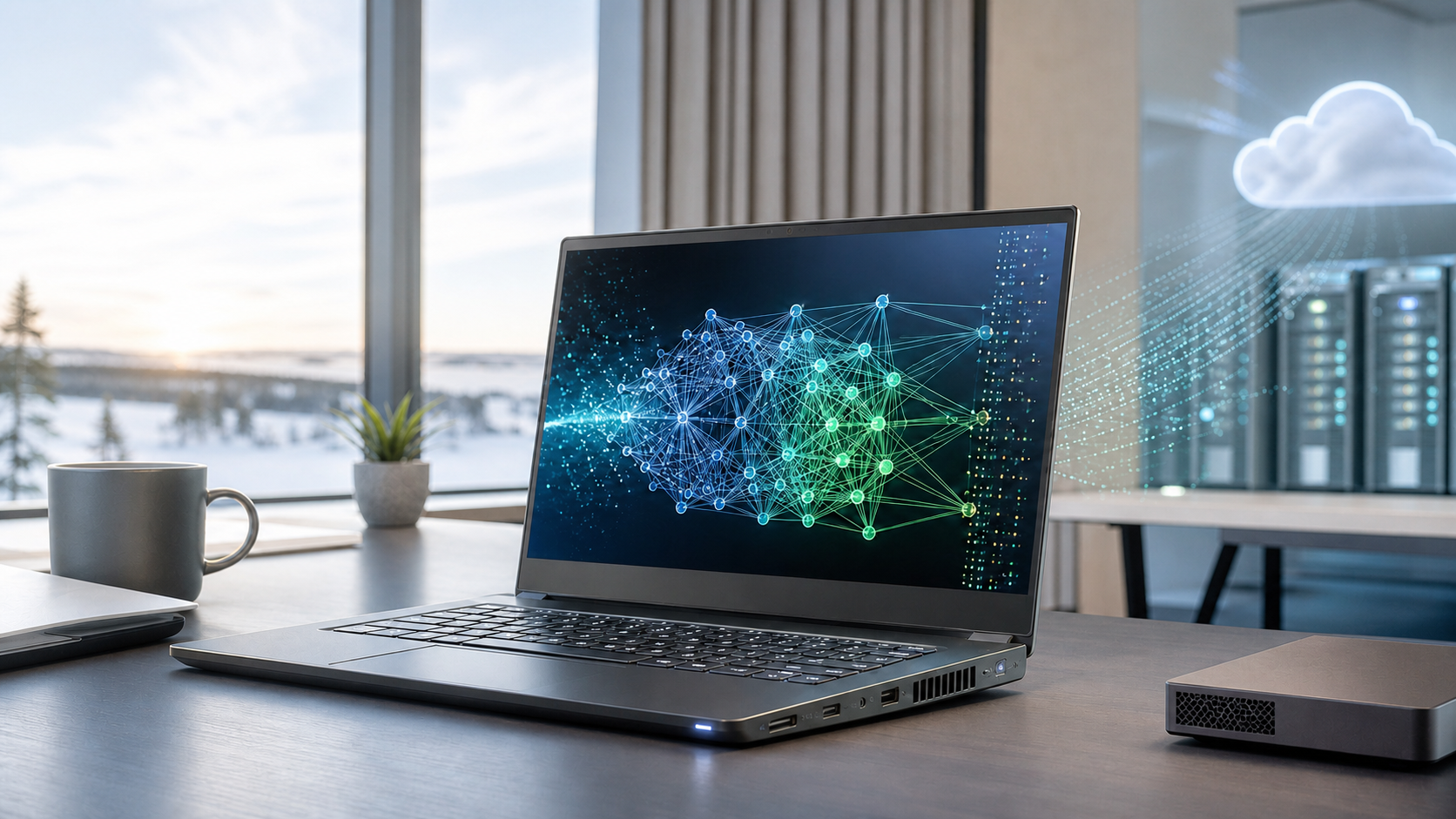
When you ask an AI system something today, the question is usually not processed on your own computer. It travels over the network to a data center, often on the other side of the world, where a large computer farm calculates the answer and sends it back. Until now, that has been necessary: good AI models have simply been too large to fit on an ordinary computer.
Last week, that requirement started to break. At Computex, Nvidia introduced its new RTX Spark chip, small enough for a laptop but still able to run a very large AI model locally, without an internet connection and without a data center. A couple of years ago, the same job would have needed a room full of servers. The first machines using these chips are expected to go on sale this autumn from familiar manufacturers: Microsoft, Dell, HP, Lenovo and Asus.
What does local AI mean in practice?
Think of the difference like this: until now, using AI has been like calling an expert abroad every time you have a question. The call costs money, the answer takes a moment, and everything you say leaves the building. Local AI means that the same expert is sitting in your own office. You ask directly, the answer comes immediately, nothing leaves the machine, and nobody charges you per call.
That creates three concrete changes:
Your data stays with you. When AI runs on your own machine, documents, customer data and confidential conversations never leave the device. No external service sees them.
The cost structure changes. Cloud-based AI services charge by usage: every question and every processed document costs something. A local model is paid for once as part of the device, and after that usage is practically free whether you use it ten times a day or ten thousand.
You do not need a network connection. AI works on a plane, on a ship, at a construction site and at a remote cabin, anywhere the computer can start.
Where does this actually matter? Four examples
Healthcare and wellbeing services. Patient data is among the most sensitive data there is. A clinic or physiotherapist cannot casually feed patient records into a foreign cloud service. But if AI runs on the clinic's own computer, it can help with clinical notes, summaries and smoother booking workflows without a single patient record leaving the premises.
Accounting firms, law firms and financial administration. Customer contracts, salary data and bookkeeping material are confidential. Local AI can review hundreds of receipts, find anomalies or draft contract text, and everything happens inside the firm's own walls. Confidentiality is not put at risk because the data does not move anywhere.
Small businesses and costs. Many small companies have tried AI services and noticed that monthly bills can grow surprisingly large under active use. When the model runs on your own machine, an entrepreneur can ask AI to process the whole customer register, write every offer and review a year's worth of emails without a meter running in the background.
Work outside reliable network coverage. A lot of work in Finland happens where connectivity is patchy: forestry machines, farms, construction sites and at sea. Local AI can come along and keep working even when there is no connection at all.
What this means for us at AI Generation
For us, this is not just an interesting news item. It is the direction we are already moving in. We plan to buy these devices as soon as they are available and run open source AI models on them, meaning models that are freely available without license fees.
That combination is valuable for customers: no monthly fees to foreign cloud services, no usage-based billing, and above all a guarantee that data stays fully under the customer's own control. Especially in fields where data protection has so far blocked AI use entirely, the door is now opening properly for the first time.
To be clear, the cloud is not disappearing. The largest and most capable models will continue to run in data centers, and for some tasks they will still be the best choice. But the boundary is moving, and it is moving into the size category that is enough for most everyday business work.
The question to ask this autumn
If your company has considered using AI but privacy, cost or uncertainty have slowed things down, autumn is a good moment to look again. Many obstacles that were real last year are now starting to disappear.
We are happy to help evaluate which of your workflows could be handled with local AI: securely, without ongoing usage costs and in your own language. Get in touch and we will look at it together.